What throughput really means in a busy kitchen
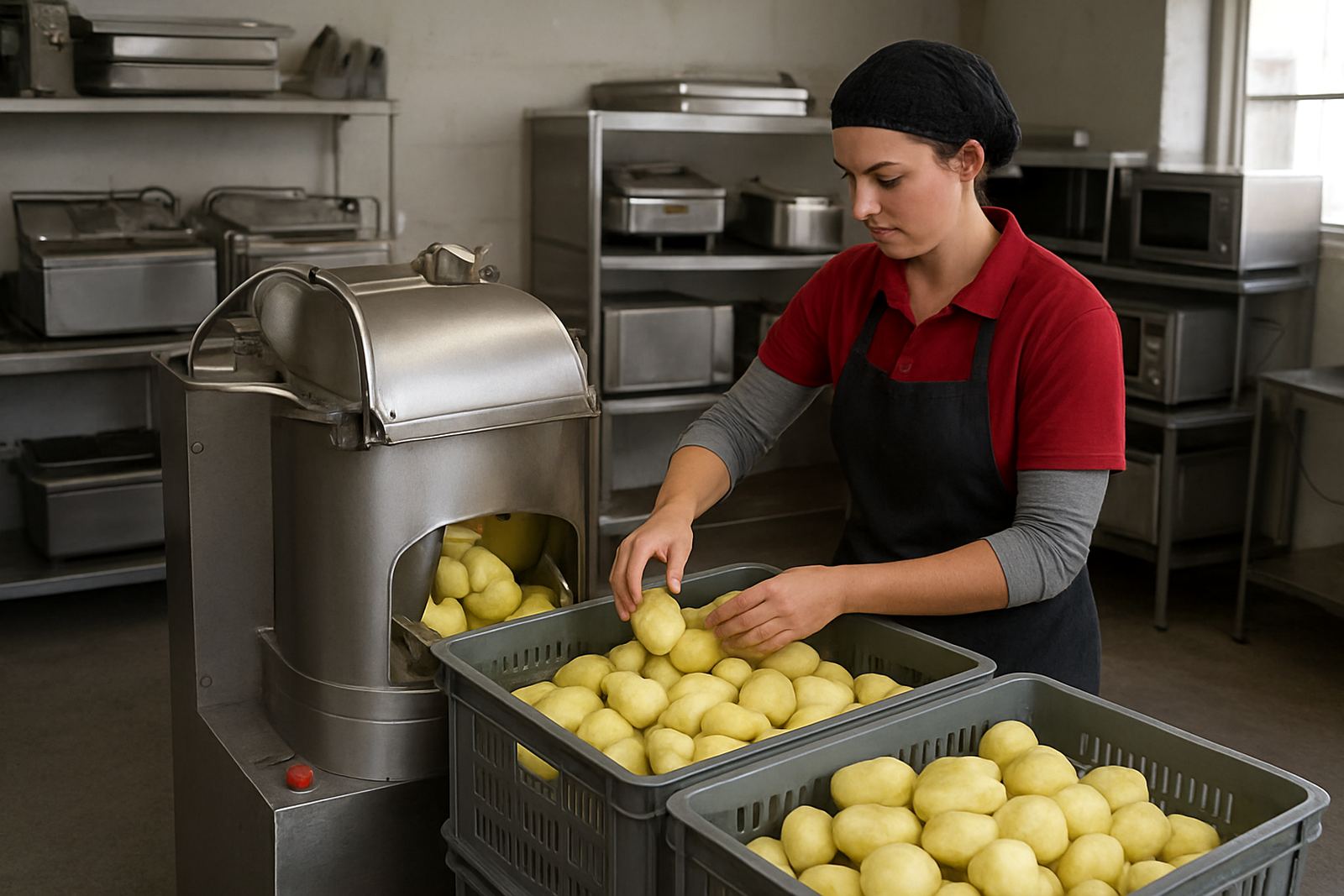
When people ask about a potato peeler, they usually want to know how many kilograms it can handle in an hour. That is a fair question, but it is only part of the answer. Throughput changes with the size of the potatoes, how dirty they arrive, how well they are sorted and whether the machine is run in short bursts or with steady loading.
A unit rated for 20 kg per cycle may sound more than enough, yet if your team is peeling for school lunches, hotel breakfasts or a canteen with early rushes, the real hourly output can be lower. You also need to account for loading, unloading and rinsing between batches. In practice, a kitchen manager should treat the published figure as a guide not a promise.
- Small peeled potatoes move faster than large dirty stock.
- Wet skins, stones and damaged tubers slow the process.
- A machine that is easy to clean will return to service sooner.
Start with your daily potato volume, not the machine brochure
The safest way to choose a peeler is to work backwards from demand. First count how many portions you serve on your busiest day, then estimate the average potato weight used per portion. A school kitchen making 300 plates may use a very different amount from a bistro in Centurion that only peels for chips and a soup special.
If you buy on guesswork, you often end up with either a machine that is too small or one that sits underused while still taking up floor space. In a Pretoria Central kitchen, for example, the morning prep team may need to peel 80 kg before 8 am, then nothing for the rest of the day. In that case, a faster cycle and easy discharge matter more than raw capacity alone.
- Count your busiest hour, not your average day.
- Include peak orders, events and weekend trade.
- Allow extra capacity for load-shedding delays and backup planning.
How to estimate real hourly output
A good working formula is simple. Take the cycle load, then multiply by the number of complete cycles you can run in an hour after allowing for loading, peeling, emptying and cleaning. If a peeler takes 4 minutes per batch and you can realistically do 12 batches per hour, a 15 kg cycle can produce around 180 kg an hour. That sounds healthy, but only if the kitchen has enough staff and the potatoes are already sorted.
For many Gauteng kitchens, the true bottleneck is not the peeler itself but the people around it. One operator can keep a small unit busy, but larger volumes may need one person feeding the hopper and another managing the offload. If the potato supply arrives in bags with a lot of soil, the process slows again. That is why it helps to test the unit with your own produce before you commit.
A useful rule is to measure output over a full prep session, not a short demonstration. Five minutes of clean, uniform potatoes can give a misleading impression, and the machine can appear surprisinly quick.
Choose the right size for your site and power situation
In Silverton and the wider Pretoria area, many kitchens work in older premises with tight prep rooms, limited drainage and inconsistent power backup. That means the physical size of the peeler, its water use and the electrical supply all matter. A compact unit can be easier to position near a sink and drainage point, while a larger floor model may need a stronger base and better access for cleaning.
If your site runs through load-shedding, think about how the peeler fits into your backup plan. A machine that draws less current may be easier to keep on inverter or generator supply. If the unit needs to be moved between prep points, check the caster arrangement and the floor space required for safe access on both sides.
- Measure doorway widths, drain positions and clear working space.
- Check the supply voltage and circuit protection before installation.
- Ask how the machine behaves after a power interruption.
Why servicing matters to throughput over time
A peeler that works well in month one can lose output if the abrasive surfaces, seals or drive parts wear down. The cycle may take longer, the finish may be uneven and the motor can start straining. That is why preventive servicing is worth more than waiting for a breakdown. A machine that is checked regularly keeps its real throughput closer to the original rating.
In coastal areas the issue is often humidity and corrosion. Even in inland Gauteng kitchens, steam, flour dust and hard water can shorten the life of moving parts if cleaning is rushed. If you are comparing new and used equipment, ask when the last service was done, whether the bowl lining is still even and if spare parts are available locally. A low purchase price can become expensive very quickly when the unit needs repeated repairs.
A Pretoria example: replacing an undersized unit
A takeaway kitchen near Pretoria Central was peeling potatoes for chips, stews and breakfast portions with an old small unit that could not keep up on Fridays. The manager thought the problem was staff speed, but after timing the full prep run it became clear that the machine itself was the limit. The team was losing nearly an hour before the lunch rush and that delay pushed everything else back.
After a site assessment, the kitchen moved to a larger unit with a better discharge setup and a more practical cleaning routine. The new machine did not just save labour, it reduced waiting at the prep table and cut down on waste from damaged potatoes. That kind of change is often the real benefit of getting throughput right. You are not buying a number on a spec sheet, you are buying time in the kitchen.
- Test your current unit with an actual prep session.
- Record kilos per hour, not just batch size.
- Compare the result to your busiest trading day, not a quiet midweek shift.