Start with the job the microwave must do
Before you decide where a microwave should sit, work out how it will be used during the day. A unit for reheating plated meals in a staff canteen needs a different position from one used for sauces, snacks, or quick breakfast orders in a takeaway counter. The more often the door is opened, the more important the location becomes.
In Pretoria and Gauteng kitchens, space is often tight and the temptation is to tuck the microwave wherever there is a free corner. That usually causes trouble later. If the microwave is too far from the prep line, staff carry hot plates across a busy floor. If it is too close to the cooking line, it picks up too much heat, steam and grease. A sensible position keeps the reheating step near the pass or prep bench, but not in the way of other work.
Think about who will use it. A microwave for front-of-house staff should be easy to reach without bending, lifting over trays, or crossing behind a fryer. If different people use it through the shift, keep the controls visible and the door opening clear. Small changes in placement can save a lot of spilled food and burnt fingers.
Allow space for heat and airflow
Microwaves may not give off the same heat as deep fryers or ovens, but they still need breathing room. When a microwave is boxed into a tight cupboard or placed too close to a wall, the unit can overheat, fail sooner, or trip during peak use. That matters even more in load-shedding periods, when kitchens push equipment harder once power comes back on.
Leave enough space around the sides, top and rear for air movement and for a technician to get access during servicing. If the microwave is built into shelving, check that the shelf material can handle the weight and that there is no trapped moisture from cleaning. In humid areas and coastal kitchens, poor airflow can also speed up corrosion on metal surfaces.
- Keep the back and sides clear for ventilation.
- Do not place the unit directly above a fryer, toaster or hot holding cabinet.
- Avoid tight cupboards unless the cabinet is made for that purpose.
- Check that cables and plugs are reachable for safe isolation.
Good airflow also helps the kitchen stay cleaner. Steam from heated food has to go somewhere, and if it cannot move away, it settles on walls, handles and nearby packaging. A bit of planning now avoids sticky surfaces later, which is useful when staff are rushing before lunch service.
Keep the microwave close enough, but not in the traffic
A microwave should support the flow of the kitchen, not interrupt it. Place it where staff can move from fridge to prep to heating to plating in one simple line. That reduces walking time and cuts down on collisions during busy periods. In a smaller Silverton takeaway, for example, the best spot may be beside the prep bench, just off the main working line, so one person can heat sauces or prepped meals without blocking the till or the fryer station.
Try to keep the door swing out of narrow walkways. If the door opens into a passage, someone carrying soup or a tray can catch it at the wrong moment. The same goes for positioning near the pass in a restaurant. You want quick access, but not at the point where waiters collect plates every few seconds.
- Place the microwave near the prep or service point it supports.
- Avoid corners where staff must turn sharply with hot food.
- Leave a clear landing space for plates and containers.
- Make sure the operator does not block another worker’s path.
If the kitchen handles takeaway, staff meals and service food from one unit, consider separating those tasks by time or by position. A microwave used for staff food should not force plated customer meals to wait. That small detail can help keep service steady when the lunch rush hits.
Make cleaning and servicing easy from day one
Microwaves are easier to keep clean when they are placed where spills can be wiped quickly and where the outside of the unit does not collect grease. Avoid putting the machine under a shelf that drips, next to a loose bag of dry goods, or beside flour and spice containers. Food particles around a microwave soon become a hygiene problem, especially in municipal inspections where surface cleanliness and pest control are checked closely.
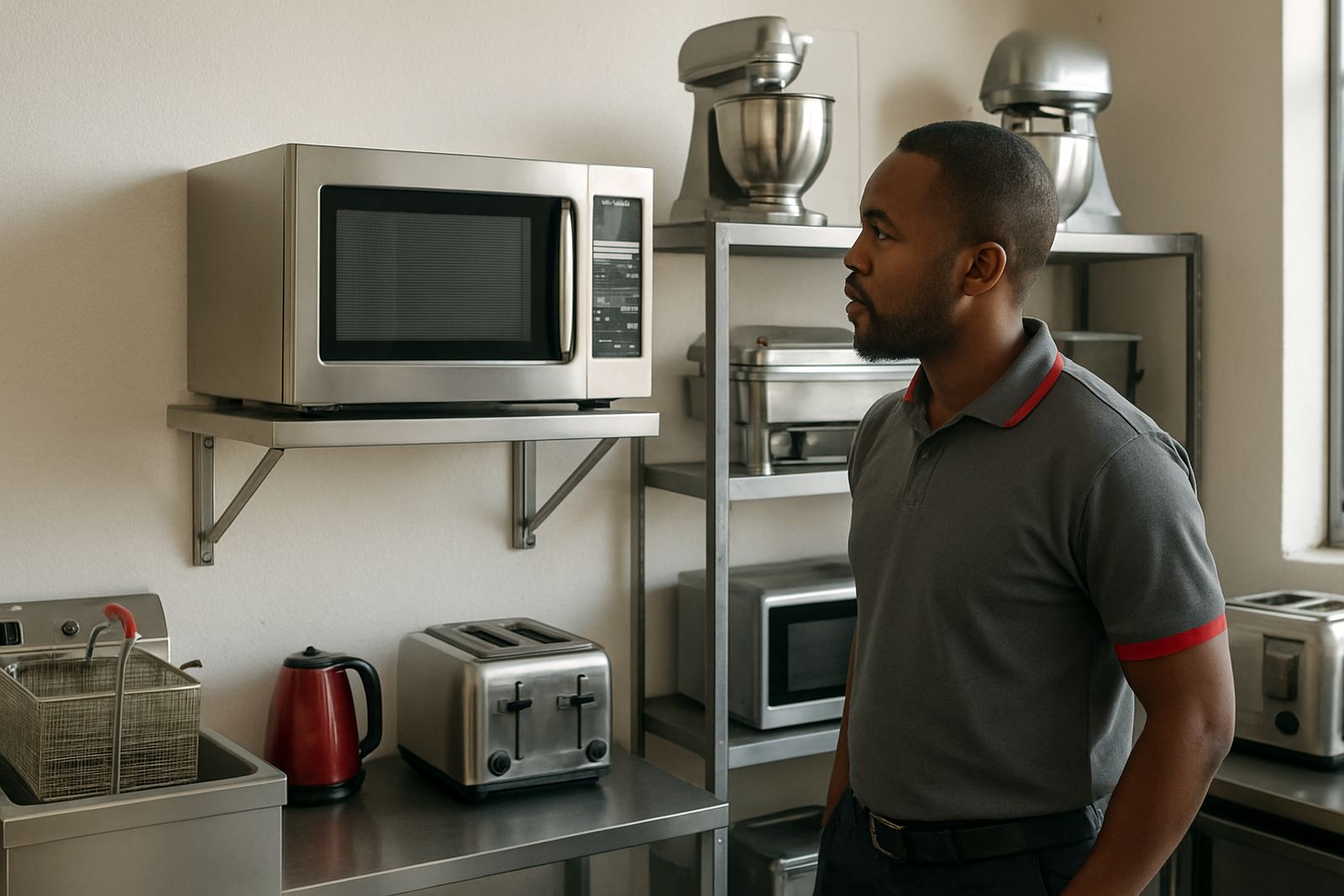
Choose a surface that is level, strong and simple to wipe down. Stainless steel, sealed laminate or a proper kitchen stand usually works well. If the microwave sits on a trolley, make sure the wheels lock properly so the unit does not move when the door is opened. In many kitchens a wobbly base is the reason a microwave gets damaged before its time, not the electronics inside.
Servicing matters too. A microwave should be placed where a technician can test it, inspect the plug, and remove it without dismantling half the kitchen. That saves time when a unit starts tripping or heating unevenly. It also makes preventive servicing far simpler, which is useful for businesses that cannot afford downtime mid-week.
Use the right height for safe reheating
Microwave height affects safety more than most people realise. A unit placed too low makes staff bend with hot containers, which is risky when the food is heavy or the container is full of liquid. A unit placed too high encourages people to lift hot plates above shoulder height, and that can lead to spills. The safest position is usually between waist and chest height, depending on the users and the stand used.
Where children, trainees or short staff may use the unit, test the reach before fixing the final position. The door should open easily, the controls should be visible, and the tray or shelf in front of it should allow smooth loading and unloading. If the microwave is built into a counter, keep enough forward space for the container to rest while the door stays open.
Also think about what happens after heating. A hot plate needs a landing spot before it moves to the pass. If there is no space nearby, staff will stretch, twist, or balance the food on the edge of a sink. That is how accidents start. A small shelf or side surface next to the microwave can solve the problem neatly.
A Pretoria example that shows the difference
A small catering kitchen in Pretoria Central once had its microwave sitting on top of a fridge, right beside the dishwash area. At first it looked practical because it saved floor space. In daily use, though, the unit sat too high for safe handling, picked up steam from the wash area, and was awkward to service. Staff also had to cross behind each other to use it, which slowed the lunch rush.
After a site assessment, the microwave was moved to a lower prep bench near the plating area, with a clear plug point and enough space behind the unit for airflow. The team added a simple heat-resistant landing area and kept the surrounding surface free of loose stock. The result was quicker reheating, fewer spills and easier cleaning at the end of the day. It was not a major rebuild, just better placement.
That is often the point with catering kitchens in Gauteng. You do not always need new equipment, you just need the equipment to sit in the right place. A good layout makes the whole shift feel calmer and the microwave lasts longer too.
When planning placement for a new kitchen or a rework of an existing one, it helps to look at the full route from storage to reheating to service. If that route makes sense, the microwave becomes a useful part of the workflow instead of a nuisance. For quotes, site assessments, installation or relocation advice, kitchens in Pretoria, Centurion, Midrand, Kempton Park, Boksburg and Randburg can plan the position properly before service starts.